Nearly all our clients are referred by existing clients, a testament to our service.
We offer clarity, common sense and total reliability, combined with financial flair.
Nationwide’s latest house price review. It believes that a slight easing in affordability pressures has helped to underpin buyer demand
According to the Nationwide, the housing market activity remained resilient in 2025, with mortgage approvals remaining near pre-Covid levels, despite consumer sentiment being relatively subdued, with households reluctant to spend and mortgage rates around three times their lows in the early days of the pandemic. It expects house price growth to be in the 2% to 4% range in 2026.
Robert Gardner, Nationwide’s Chief Economist, said:
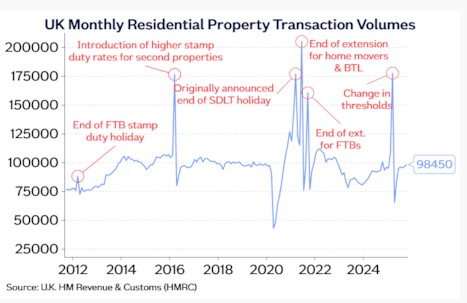
“Stamp duty changes that took effect at the beginning of April created volatility through the spring and summer. Activity spiked in March as purchasers brought forward transactions to avoid paying additional tax, and this led to some softness in the following months. However, the underlying picture was little changed as demand held up well throughout.
 “House prices evolved broadly in line with our expectations. Annual price growth slowed steadily from 4.7% at the end of 2024 to 2.1% in the middle of 2025 and then to 1.8% in November. As a result, prices were close to the all-time high recorded in the summer of 2022 as the year drew to a close.
“With price growth well below the rate of earnings growth and a steady decline in mortgage rates, affordability constraints eased somewhat, helping to underpin buyer demand. The first-time buyer share of house purchase activity was above the long run average, supported by easier credit availability, with the share of high loan to value lending (i.e. with a deposit of 15% or less) reaching its highest level for over a decade.”
According to the Nationwide, annual house price growth in Northern Ireland outpaced the rest of the UK by a wide margin, averaging 11% in the first nine months of the year, almost four times faster than the 3% recorded in the UK as a whole and more than double the 5.1% recorded in the next strongest performing region (the North of England). This strong performance mirrored that in the border regions of Ireland over the same period.
However, it said, despite these significant price gains, house prices in Northern Ireland are still around 6% below the all-time high recorded in 2007, while UK prices are almost 50% higher over the same period. As a result, the price of a typical home in Northern Ireland is currently around 79% of the UK average price, while in 2007 it was around 25% higher.
It found that Wales broadly matched the wider UK trend in 2025, while Scotland saw a marginally stronger rate of house price growth.
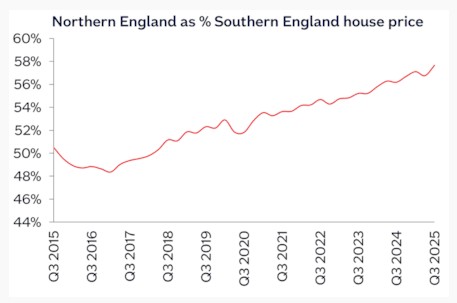
According to the Nationwide, London was the weakest performing region in the first nine months of the year with annual growth averaging 1.3%. This was part of a wider trend that saw house price growth in the northern regions of England outpacing the southern regions. As a result, the price differential narrowed to its lowest since 2013. The average price of a home in northern regions of England is now almost 58% of that in the southern regions, well above the lows of c48% seen in 2017.
 Looking ahead to 2026, the Nationwide expects housing market activity to strengthen a little further as affordability improves gradually (as it has been in recent quarters) via income growth outpacing house price growth and a further modest decline in interest rates. It expects annual house price growth to remain broadly in the 2% to 4% range next year.
Mr Gardner added: “The changes to property taxes announced in the Budget are unlikely to have a significant impact on the market. The high value council tax surcharge is not being introduced until April 2028 and will apply to less than 1% of properties in England and around 3% in London. The increase in taxes on income from properties may dampen buy-to-let activity further and hold down the supply of new rental properties coming onto the market, which could in turn maintain some upward pressure on private rental growth.”
You can read the full Nationwide report here.
Source: Techlink Professional
This is a news bulletin and is up-to-date as of the date of publishing. Please check the publishing date at the top of the article.
Essential Wealth Management
1-2 Great Farm Barns
West Woodhay
Newbury
Berkshire RG20 0BP
Tel: 01488 669840
Fax: 01488 669216
Email: [email protected]
Essential Wealth Management is a trading name of Essential Wealth Management and Advice Ltd which is an appointed representative of 2plan wealth management Ltd which is authorised and regulated by the Financial Conduct Authority. Essential Wealth Management and Advice Ltd is entered on the FCA register (www.FCA.org.uk) under no. 518528. Registered office: 1-2 Great Farm Barns, West Woodhay,Newbury, Berkshire RG20 0BP. Registered in England and Wales Number: 04020006.
The Financial Ombudsman Service is available to mediate individual complaints that clients and financial services businesses aren't able to resolve themselves. To contact the Financial Ombudsman Service please visit: http://www.financial-ombudsman.org.uk/contact/index.html
The information on this website is subject to the UK regulatory regime and is therefore targeted at consumers in the UK.
Approved by 2plan wealth management Ltd on 20/05/2025